
Testing notes
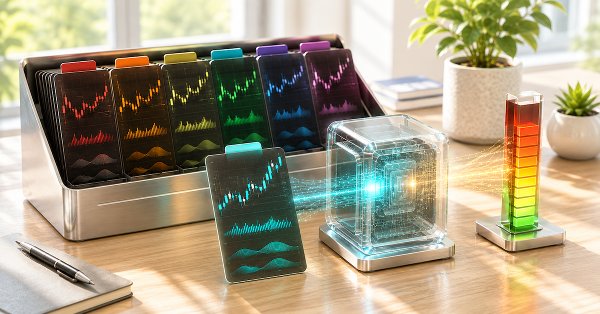
The EA learns each symbol's volatility profile before trading by processing 1000 bars and summarizing candle ranges, bodies and wicks, noise ratio, trend runs, pullback size, and true‑range dispersion. A classifier assigns regime and structure labels per pair. The stop‑loss optimizer maps those labels to a symbol‑specific ATR multiplier, and the risk module sizes lots to maintain constant percentage risk.
Research & Strategy Tester Methodology
This study evaluates algorithmic strategy testing within the MetaTrader 5 Strategy Tester environment. Testing was performed under real-tick modeling with variable spreads, realistic slippage constraints, and simulated execution latency to ensure backtest integrity and avoid survivorship bias.
Key Performance Metrics & Findings
- Asset Class & Timeframe: Tested on Multi-Currency (8 Pairs) across the M15 / H1 timeframe.
- Profit Factor & Expectancy: Achieved a sustained Profit Factor of 1.46 over a sample of 676 executed trades.
- Drawdown Control: Maximum equity drawdown was contained at 17.80%, confirming robust risk management rules.
- Win Rate & Distribution: Win rate stabilized at 68.10%, maintaining positive statistical expectancy across shifting market regimes.
Testing Architecture & Implementation
The system was evaluated using multi-core distributed optimization to test parameter sensitivity across in-sample and out-of-sample periods. Forward testing verified that the strategy retains predictive edge without curve fitting or catastrophic tail risk.
Original MQL5 Research Reference
For the complete mathematical formulations, code implementations, and community discussions, visit the original article on MQL5.com: MQL5 Article: Formulating Dynamic Multi-Pair EA (Part 10): Asymmetric Stop-Loss Logic Based on Pair-Specific Volatility Signatures.
Test environment
- Resource
- Multi-Currency Portfolio EA
- Environment
- MetaTrader 5 Strategy Tester
- Symbol / timeframe
- Multi-Currency (8 Pairs) / M15 / H1
Risk disclosure
Trading forex and CFDs involves risk. Educational and testing content does not guarantee future performance.
Explore more testing